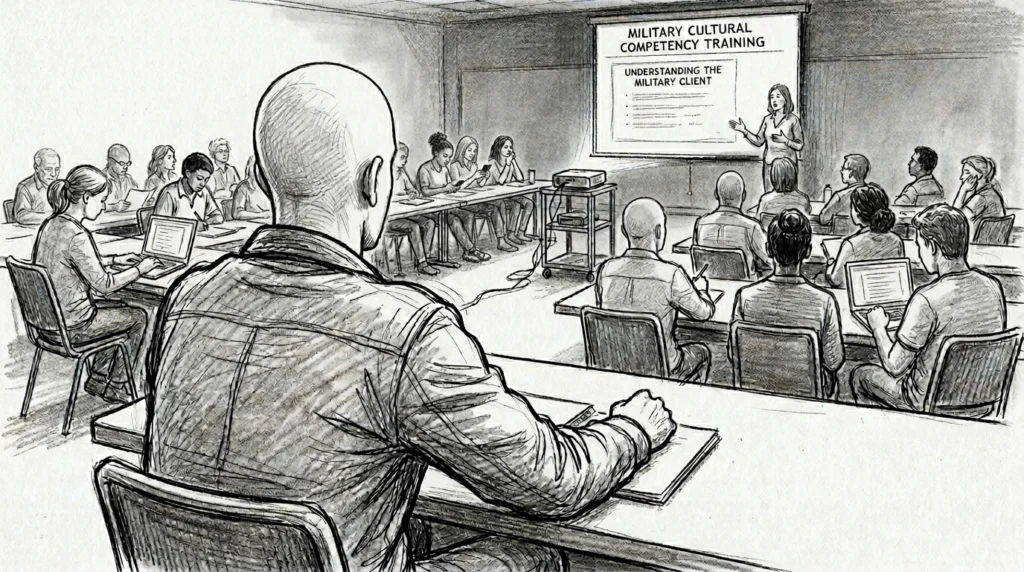
I was sitting in a large room with about two dozen other therapists. In front of us was a projector and the instructor who was reading off a slide deck focused on understanding military culture. I noticed it start coming up for me, even before the class began, and it wasn’t the first time sitting in a similar training that I noticed it.
There was a sense of annoyance I couldn’t quite shake — sitting in those rooms, watching slides load, listening to someone walk through military ethos and culture and unique stressors like they were reading from a field manual. “Who do you all think you are?” I’d think to myself. “You’re going to understand life in the military from a PowerPoint?”
It didn’t matter how well-intentioned the instructor was. It didn’t even matter if they were a veteran themselves. Something about the format bothered me — the reduction of a culture, my culture. Like something enormous and intangible was being folded down small enough to fit onto a 5 page handout at the end of a few hours.
I would look around the room and just observe. I would see some therapists who were hanging on every word, trying to soak in what the instructor was saying, like they were going to walk away prepared to work with veterans, others who were scrolling on their phones or just doodling on the handout, not listening to anything. A part of me wanting to just get up and walk out in a silent protest to it all. Another yearning to go back to the very culture that was being described. Both reinforcing a feeling I have felt since entering the civilian world — I was out of place.
It all irritated me.
Not because I thought I was better than anyone in that room, or because anything being taught was factually wrong. It irritated me because it was mine. It was my lived experience, my fellow servicemembers’ experiences — something unique to each branch, each person who ever wore a uniform.
Because for a lot of people who serve, the military isn’t a job. It’s not a lifestyle you adopt or a culture you join. It becomes part of the fabric of who you are — woven into the way you think, the way you carry yourself, the way you make sense of the world.
Watching it get summarized and labeled as competency training felt wrong.
What Lived Experience Actually Makes Possible
When I work with any client, I am mindful to check my assumptions. I get curious. Despite my own background in the military, I know that theirs is not the same as mine.
While I had a positive career as a Marine, not everyone who serves experiences that. I recently had an Army veteran who started therapy with me. I could have started to build the therapeutic relationship by trying to connect with him on service, the hardships, some good ‘ol inter-service rivalry and would have fallen flat — because his experience was not a great one. In fact, it ended not by choice. But because I made sure to be curious about what his experience was like before moving forward, I learned that it started off well. I came to understand there was still a connection to the values that being in the Army instilled. I was able to use those values in our sessions in a way that supported and helped build the therapeutic relationship and move things forward. Had I not taken the time to understand who he was and what his experience was like, I would have failed him.
That’s why curiosity must override assumption — even when shared background might have made assuming feel safe. But there are also times where the shared experience itself becomes part of what makes the work possible.
Often, a veteran will enter therapy already feeling isolated, alone, out of place in their world. Having a space where shared experiences allows the client to feel understood in ways that are otherwise difficult to replicate. It may be in framing an intervention through a lens of service that resonates and lands more effectively, or because when they talk about their experience, a head nod and “mm-hmm” conveys an understanding and they don’t have to explain or feel judged. It’s a visceral moment that no basic attending skill can replicate.
A particular instance comes to mind where a veteran client was talking about being married with a family in the military. The conflict of what it means to be a good husband and father against the demands of “mission first” and being a soldier. I have lived that difficult choice before. I could empathize — not because I knew what it was exactly like for them, but because I understood the internal conflict of personal values that are often at odds. When being a Marine means family comes second.
Another moment of connection and healing through shared experience that comes to mind is a Marine veteran talking about their deployment experience. As they processed some of their experiences, painful and intense, they shared a memory — one many might consider shocking — that made the client laugh. Instead of feeling judged or shutting down from shame, they felt understood as I involuntarily laughed with them, knowing exactly why we found humor in that moment, in the midst of the pain.
Lived experience matters. I believe that. I’ve seen it matter in ways that are hard to quantify but impossible to ignore — in a laugh that didn’t need explaining, in a conflict between values that I didn’t need a slide deck to understand, in a client who finally felt like they didn’t have to translate themselves for the person across from them.
And yet…
Blind Spots
As I reflected and prepared to write this post, something I didn’t expect happened. What started as a critique of cultural competency training ended up turning the lens back on me. Because the certainty I carried into those training rooms — that no civilian therapist could ever really bridge that gap — was its own kind of assumption. Quieter than a PowerPoint slide. But the same problem.
My reaction in those trainings wasn’t just about protecting something meaningful. It was also an assumption — a quiet, unexamined belief that military experience was mine in a way that couldn’t be crossed. That no amount of genuine curiosity or good clinical instinct from a civilian therapist could bridge that gap. And so I held it close, and I held them at a distance.
The problem is that assumption — any certainty about what someone else can or can’t understand — closes the same door I was frustrated to see the trainings close. The trainings assumed too much access. I was assuming too much exclusivity. Different directions, same wall.
I’ve worked alongside civilian therapists who would never claim to know what it’s like to serve. Who walk into a room with a veteran client and lead with genuine curiosity rather than assumed understanding. Who ask questions not as a clinical technique but because they actually want to know. And I’ve watched that matter. I’ve watched veterans open up in those rooms in ways that had nothing to do with whether the therapist had worn a uniform.
Service doesn’t open the door. Curiosity does.
Curiosity Creates Connection
Know yourself and seek self improvement. It’s a Marine Corps Leadership Principle that has stayed with me since boot camp, long after the uniform came off.
Curiosity about our clients — and about ourselves — is what invites growth and change in the therapeutic process. Trainings have their place. They create context, starting points, a framework to begin asking better questions. But they were never meant to be the finish line.
The most important thing any therapist can bring into a room isn’t credentials or shared experience. It’s the genuine willingness to not assume. To stay curious about this person, this story, this experience — one that has never existed before and won’t again.
Veteran or not. That’s true for all of us.
Your Story Doesn't fit Into a Slide Deck
If you’ve ever felt misunderstood by a therapist — or you’re not sure it’s worth trying again — I’d be glad to talk. I can’t promise I’ll get everything right. I can promise I’ll keep asking questions.