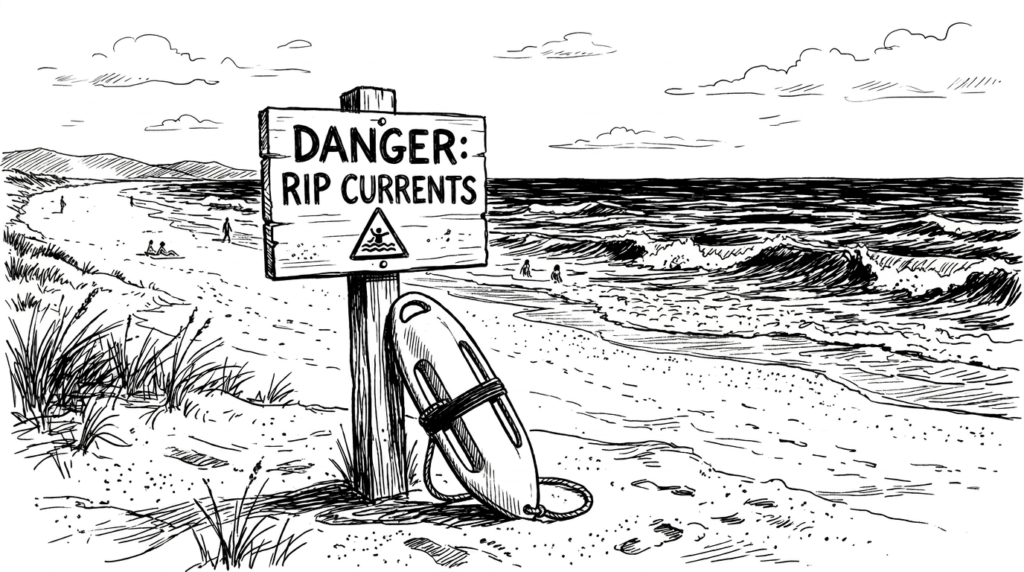
When you’re caught in something overwhelming—anxiety that won’t let up, depression that makes everything feel impossible, stress that’s got you paralyzed—every instinct tells you to fight it head on. Push through it. Make it stop. Get back to normal as fast as possible.
That instinct makes perfect sense. It’s also what exhausts you.
Years before I became a therapist, I learned this lesson in the ocean. And I see the same pattern play out in my office every single day.
The Long Swim Back
When I was in high school, I had a summer job as a beach attendant at a small ocean front hotel. Though we didn’t have an official lifeguard on staff, we kept a rescue buoy in the supply box.
As my friend and I were at our attendant station, we started to hear faint yelling from the water. As we looked out, we could see someone being taken away from shore quickly.
We immediately jumped up, grabbed the rescue buoy, and ran toward the surf. Once through the breakers, we swam as fast as we could to the guest. After she had the buoy and we reassured her, we looked back toward shore.
We realized we were a good 75-100 yards out by this point.
Now, we had to make a choice. We could try to tread water while we waited for a rescue boat, but the buoy isn’t big enough for more than one person and we had no idea how long rescue would take. We could try to swim against the rip current straight back to shore—possibly make it back, but the risk of three casualties was high due to exhaustion. Or we could do the safest and smartest thing: take the long swim back to shore.
There was only one reasonable choice. We would have to swim parallel to the shoreline far enough to break free from the rip current, before pivoting and being able to swim freely back to safety.
The swim back was arduous—already exhausted from reaching the guest, now towing dead weight through the water. Finally back on the sand, the guest was safe with her family. We sat in the shade of an umbrella, and the adrenaline dump hit us hard.
After a brief rest, we went back to our usual duties and finished out the day. As we finished shutting down and packing everything up for the evening, the sun began to set, casting its bright orange glow across the horizon. As I walked up the stairs off the beach that day, I looked out over the water and had even more respect for the power underneath that beauty.
Why Swimming Straight Back Drowns You
Here’s what makes rip currents so dangerous: they’re stronger than you are. Even strong swimmers exhaust themselves trying to fight directly back to shore. The current doesn’t tire. You do.
The counterintuitive truth—the thing that saves your life—is that you don’t swim toward safety. You swim parallel to the shore, perpendicular to the current’s pull. You move sideways until you’re free of the current, and only then do you angle back toward shore.
It feels wrong. Every instinct screams to get back to safety as fast as possible. But that instinct, in a rip current, will drown you.
I don’t recall what brought this memory back to me the other day, but as I thought about that rip current—the nearly invisible power it had, the speed at which it took our guest far from shore—it connected to something I’ve noticed about how emotions have the same impact as that rip current, and how we need to recover from it in a way that seems counterintuitive.
You take the long swim back.
When You're Caught in an Emotional Rip Current
Anxiety, stress, depression, burnout—they’re kind of like that rip current. They catch you off guard, aren’t always noticeable at first, and when you realize it’s happening, you’re far from the safety of the shore.
Emotions are powerful. If you try to push back directly against them, you usually won’t make much progress, if any. Any progress you do make will be exhausting, and you risk drowning in them. You could ride the emotion out, or wait for rescue, but treading in the emotion is as exhausting as treading water—and you have no idea how long the emotion will last or when rescue will come.
Instead, when we realize we’ve been caught in that emotional rip current—no matter the emotion—we need to respond, not react.
Responding vs. Reacting
Reactions are automatic responses driven by emotion. They’re what every instinct tells you to do:
When anxious: Try to control it, make it stop, think your way out of it, avoid anything that triggers it
When depressed: Push through it, force yourself to be productive, “just snap out of it,” hate yourself for struggling
When burned out: Ignore the exhaustion, keep giving from empty, tell yourself you should be able to handle this
When relationship conflict feels overwhelming: Demand immediate resolution, force the conversation when you’re both flooded, insist on answers right now
These reactions make sense. They’re what your brain defaults to when you’re caught in the current. But they’re also what exhausts you—because you’re swimming straight back against a force stronger than you are.
What we need to do instead is respond to the emotion. We need to identify that we’re caught in that emotional rip current. Assess what’s happening. Then start swimming in a direction that feels counterintuitive. We go sideways, not back to safety, so we can break free of the current. Once we’re out of danger from the current, then we can pivot back and make our way to shore.
What Swimming Parallel Actually Looks Like
With Anxiety: Breaking Free of the Current
I had a client recently who was caught in an emotional rip of anxiety. They had career, financial, relational, and personal stressors that had them paralyzed, unable to make decisions, unable to make a move in any direction. They were literally having panic attacks daily.
So in session, I threw them the buoy and allowed them to just breathe. Then, we discussed going sideways to the shore before we started to make our way back. That looked like really taking time to identify everything feeding into the anxiety, processing the things we couldn’t control, and identifying areas we could affect change in.
We weren’t going back to shore. We were taking our time to break out of the current, get away from the anxiety. Then, we were able to start making progress back.
Swimming parallel with anxiety doesn’t mean making it go away. It means acknowledging it’s there, identifying what’s feeding it, and making small moves that don’t require you to fight the current directly.
With Depression: Accepting What You Can Actually Do
I’m working with a client who struggles with depression and the relentless “should” statements that come with it. She should be better at her job. She should be better at dealing with emotions. She should be better at everything.
So she would push herself beyond her abilities, refuse to ask for help, and constantly compare her performance to others. The comparison just increased the emotional distress. The distress increased the depression. The depression wore her down even more. It was a self-feeding cycle—swimming straight back while carrying the dead weight of depression, exhausting herself faster with every stroke.
In our sessions, we focused on her values and her abilities. We got to a place where she could see she was stuck in that cycle. She allowed me to hand her a buoy and stop exhausting herself. We swam sideways out of the current so she could breathe. Then we slowly started back to shore together.
Swimming parallel looked like focusing on what was important to her and her values—not what she thought she should be doing or what others were accomplishing. Setting realistic goals based on her actual capacity. Finding personal acceptance for her strengths and identifying her struggles without judgment.
Instead of “I should be doing more,” it became “I am doing the best I can, how I can.” Small, incremental, attainable goals that allowed her to make gains without the self-criticism. The movement creates space. And in that space, she started to break free of the current’s pull.
With Relationship Overwhelm: Creating Space First
When conflict in a relationship feels overwhelming, couples usually come to therapy to get answers and be “fixed.”
I have a couple I work with where one partner says they need “space” and walks away, which creates significant anxiety and distress for the other partner. One partner feels flooded and withdraws for relief—which creates flooding for the other partner who’s left without closure or reassurance.
Swimming parallel looks like: “I am noticing that I am really overwhelmed with my thoughts and feelings right now and feel like shutting down. Can we take a 15 minute pause? I love you and this is important to me, I just need a few minutes to sort myself out. We are going to be OK.”
The counterintuitive move: step away from the fight to get back to the relationship.
With Burnout: Taking the Break You Need
Another client I worked with recently was stuck in a current of burnout. Stressed and overwhelmed, they had just gone through some difficult experiences and were trying to keep going without catching their breath. They weren’t in the rip anymore, but they were a long way from shore. They tried to keep pushing on as hard as they usually do—yet they were physically and mentally exhausted.
Our work together gently guided the client to take a break. We processed. We experienced the weight of all the loss and stress they had gone through recently. It was an emotional adrenaline dump. We talked about what the rest of the shift looks like, and when they used that break to catch their breath, they were much more ready to get back to life.
Swimming parallel with burnout looks like acknowledging you’re running on empty and that rest isn’t weakness—it’s what makes continued functioning possible.
The Buoy
In the ocean that day, the buoy didn’t swim for the woman caught in the rip current. But it gave her something to hold onto while she caught her breath. It gave her what she needed to stop fighting and let us help her get back to shore.
That’s what support looks like in an emotional rip current too.
Therapy isn’t about someone doing the work for you. It’s about having something to hold onto while you catch your breath. It’s about someone helping you identify that you’re caught in a current, showing you the sideways path out, and swimming alongside you while you make the long journey back.
The buoy doesn’t do the swimming. But it makes the difference between exhausting yourself alone and having what you need to make it back.
You're Not Drowning Because You're Weak
My friend and I had to take some time to recover from the adrenaline dump and catch our breath before getting back to normal. That was what our bodies needed after fighting a current and towing someone to safety.
If you’re exhausted right now—if anxiety, depression, burnout, or overwhelm has you feeling like you’re barely keeping your head above water—it’s not because you’re broken. It’s because you’re caught in a current, and you’ve been doing what every instinct tells you to do: fighting straight back to shore.
The problem isn’t that you’re weak. The problem is that the current is strong, and swimming directly against it will always exhaust you.
The work isn’t about fighting harder. It’s about learning to swim parallel. It’s about identifying the current, making the counterintuitive move, and taking the long way back. And sometimes, it’s about letting someone throw you a buoy while you catch your breath.
That’s not giving up. That’s survival.
And on the other side of that long swim—when you’ve broken free of the current and made your way back to shore—you get to sit in the shade, catch your breath, and remember that you made it.
If You're Caught in the Current
The work of identifying what’s pulling you under and finding the counterintuitive path back to shore is something we can do together. If you’re exhausted from fighting and ready to try swimming parallel, I’d be happy to talk.