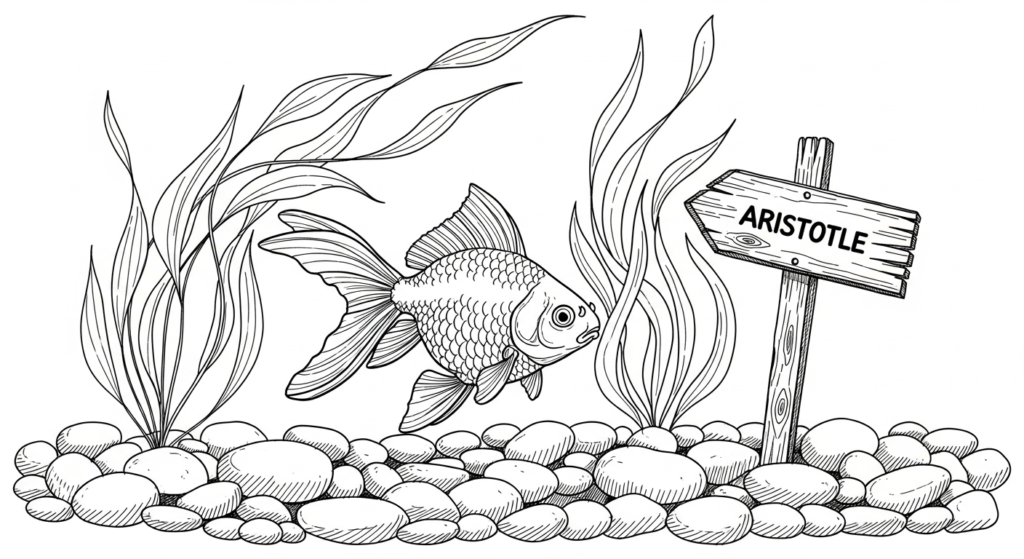
About 20 years before I ever considered becoming a therapist, I was intrigued by philosophy. I never studied it — but the unanswerable questions, the search for meaning, something about that pulled at me. It was around that time I had the most random thought: if I ever got a goldfish, I’d name it Aristotle. Why a goldfish? Why Aristotle? No idea. But the name stayed with me. Years later, in a difficult season of life, I found myself searching for Aristotle quotes — looking for something, though I couldn’t have told you exactly what. Then I found it, and it has lived on my office wall ever since.
"Prefer probable impossibilities to improbable possibilities."
Aristotle was writing about storytelling — specifically, what makes a story work. His argument was that a good fiction doesn’t have to be true. It has to be believable. A story built around something impossible but internally consistent will land harder than one built around something that actually happened but strains credulity. The impossible thing that feels real beats the real thing that feels impossible.
That’s what he meant. A craft argument about narrative.
That’s not what landed.
What landed was something about the darkest moments. When everything around you seems to be failing. When the voices around you have given up. When your own mind is telling you it’s hopeless, it’s pointless, just stop.
All it takes is a glimmer. Not certainty. Not proof. Just the faintest sense that something is possible — even when it seems wildly improbable — to find the strength to keep going.
That’s the probable impossibility. The thing that seems unreachable but somehow we still have belief enough to move toward. That hope that simply won’t let go.
And here’s what I’ve come to believe about the second half of the quote: the moment we let go of that glimmer — surrender to the lies, the obstacles, the voices inside or outside that say it’s over — even the genuinely possible becomes unreachable. Not because it stopped being possible. Because we stopped being able to see it.
What I’ve seen, sitting with people in those seasons, is that healing rarely begins with certainty. Nobody walks in knowing it’s going to get better. They walk in carrying something — a question, an exhaustion, sometimes the smallest ember of hope, desperate for oxygen. Just the faintest sense that things don’t have to stay exactly like this.
That ember is enough. However improbable it feels, it can roar back to life.
The work isn’t about manufacturing hope out of nothing. It’s about finding what’s still believable — and giving it air.
Need to find your goldfish?
Maybe therapy has always felt like an improbable idea. But you’re here, reading about a goldfish and a Greek philosopher. Maybe that’s something.
If you’re in the middle of a season of change or transition, you can learn more about how we can work together here. Or whenever you’re ready —